Technical guide
Boiler heating element: how to test with a multimeter, diagnose and choose
With the machine disconnected from the mains and the wires removed from the terminals, a healthy heating element measures roughly R = V²/P (about 17.6 Ω for a 3000 W element at 230 V) and shows no continuity between its terminals and the flange. An open circuit or an earth leak means replacement.
How do I test a boiler heating element with a multimeter?
You measure the ohmic resistance of each coil and the continuity between the terminals and the flange, always with the power off. The test is done at the terminals, without opening the boiler:
- Disconnect the machine from the mains, confirm there is no voltage and let it cool down.
- Photograph the wiring and remove the wires and the links between coils from the terminals; with the element left in circuit, other components in parallel distort the reading.
- Select the ohms range, touch the probes together and note the resistance of the leads themselves (typically 0.2 to 0.5 Ω) so you can subtract it.
- Measure across the two terminals of each coil and compare with the calculated value.
- Measure between each terminal and the flange: the meter should show an open circuit (OL).
What ohm reading should a healthy element give?
The expected value is calculated as R = V²/P, using the voltage and power stamped on the element. The usual industry tolerance on ohmic resistance is +10 % / −5 %, and a reading within that margin is normal.
| Power at 230 V | Total resistance (one coil, or all in parallel) | Per coil, with three equal coils |
|---|---|---|
| 2000 W | 26.5 Ω | 79.4 Ω |
| 2600 W | 20.3 Ω | 61.0 Ω |
| 3000 W | 17.6 Ω | 52.9 Ω |
| 4000 W | 13.2 Ω | 39.7 Ω |
| 5400 W | 9.8 Ω | 29.4 Ω |
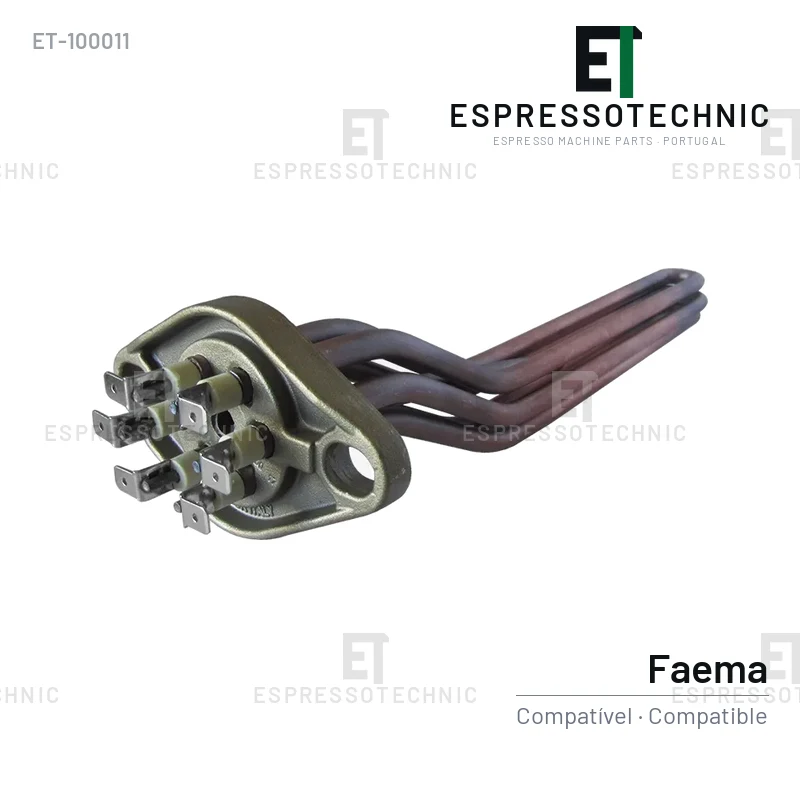
The right-hand column applies to elements with three 230 V coils (six terminals), which can be wired for 230 V single-phase (in parallel) or 400 V three-phase (in star). A coil that reads open circuit is broken: the machine still heats, but more slowly.
How is an earth leak in the element detected?
Any reading other than open circuit between a terminal and the flange indicates an earth leak, and the element must be replaced. The reverse is not guaranteed: a multimeter tests with only a few volts, and an element with moisture in its insulation can pass this test and still trip the residual current device in service.
The proper test is made with an insulation tester at 500 V DC, with the machine wiring disconnected from the element; the tester puts dangerous voltage on the terminals. As a reference, Chromalox gives typical values of 20 MΩ or more per element and considers that, at 1 MΩ or less, the element should not be given full power. In a boiler, a cracked sheath lets water in again, so the answer is replacement. La Marzocco requires the installation to have an RCD of 30 mA at most.
What are the symptoms of a failed heating element?
The usual symptoms are a boiler that does not heat or takes much longer to heat, and the residual current device tripping during heat-up. None of them points to the element alone, so measure before replacing.
- No steam or cold coffee: manuals also list a pressostat with oxidised contacts, a tripped protection thermostat and faulty connections.
- Slow heating: a broken coil or limescale on the element. C.M.A. says to check for limescale on the element at least once a year.
- RCD tripping: earth leak, for example through a perforated sheath.
- Safety thermostat tripped: usually the element was left uncovered for lack of water. Before resetting, the Astoria manual says to find out why the boiler failed to fill.
How do I choose the replacement element?
The new element must have the same power, the same voltage, the same mounting and the same length as the one fitted.
- Power and voltage, stamped on the element. Among the 2-group elements in our catalogue, power ranges from 2600 W to 5400 W depending on the brand.
- Number of coils and terminals, and the wiring scheme (230 V or 400 V).
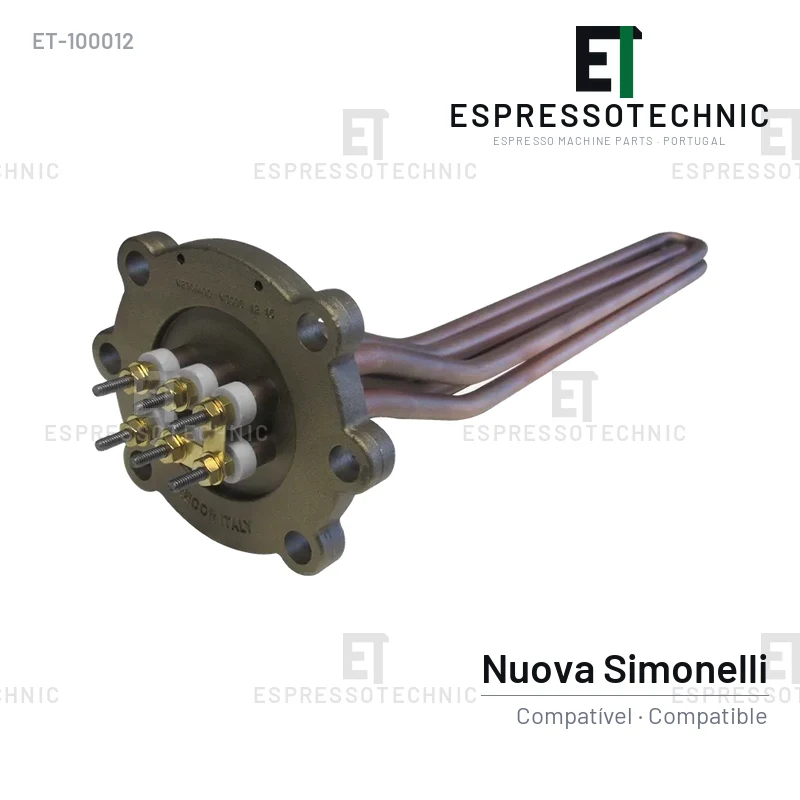
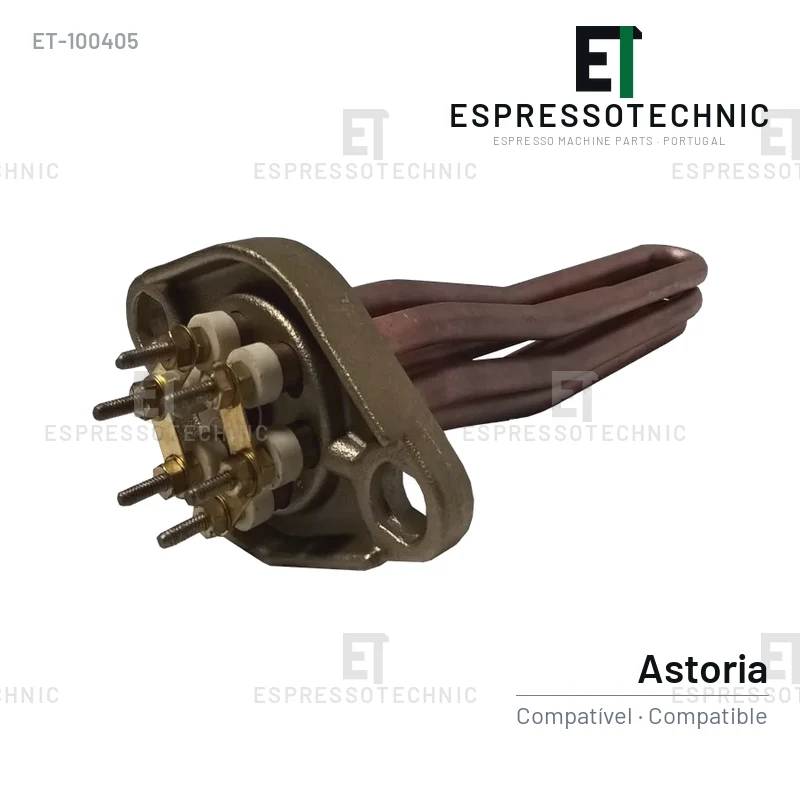
- Mounting: threaded flange (for example, 1¼″) or bolted flange; measure the diameter and count the holes.
- Length under the flange: it must fit inside the boiler and stay covered by water at all times.
- Pocket for a probe or thermostat, if the element fitted has one.
- New gasket or O-ring at every fitting, with the seating surface clean and dry.
Heating elements are under Boilers & Heating; gaskets and O-rings under Gaskets & O-rings; thermostats and level probes under Sensors & Instruments.
FAQ
- What makes a heating element burn out?
- The two main causes are running without water and limescale. Makers of immersion heaters require the heated section to be covered by liquid at all times and warn that deposits cause overheating and premature failure. On the machine, that calls for a clean level probe and treated water.
- Can I fit a more powerful element to heat up faster?
- No. The Astoria manual expressly forbids it. The wiring, the pressostat or contactor and the electrical supply are sized for the power specified by the manufacturer.
- The element measures fine but the machine does not heat. What should I check?
- The safety thermostat, which may need resetting, the pressostat contacts, the contactor, the fuses and the tightness of the terminals. La Marzocco includes tightening the cables on the terminal block and inspecting the contactor in its yearly service.
- Does the boiler have to be drained to test the element?
- No. The measurements are taken at the terminals, with the machine disconnected from the mains. Only to remove the element does the boiler have to be cold, depressurised and empty.
Related part families
Prices and availability on request. We reply in English or Portuguese.