Technical guide
Rotary vs vibratory pump: how to tell them apart, diagnose and replace
A rotary vane pump is driven by a separate motor, delivers a continuous flow and sets its pressure with a built-in by-pass; it is the usual choice on plumbed-in professional machines. A vibratory pump is a small electromagnetic piston pump, compact and rated for intermittent duty, whose pressure is limited by a separate valve.
What is the difference between a rotary and a vibratory pump?
The difference is in how the water is compressed. In a rotary vane pump, a separate electric motor spins a rotor fitted with graphite vanes; the flow is continuous and the surplus returns to the inlet through an adjustable by-pass. In a vibratory pump, a coil drives a small piston back and forth; the flow is pulsed and the pressure is limited by a valve fitted after the pump.
| Feature | Rotary vane | Vibratory |
|---|---|---|
| Flow | Continuous; 70 to 400 l/h nominal in the Fluid-o-Tech PO 70-400 series | Pulsed; 650 cm³/min at most (about 39 l/h) on the CEME/Ulka E5 |
| Maximum pressure | 16 bar discharge (PO 70-400 series) | 15 bar (E5) |
| Pressure setting | Built-in by-pass, on versions that have one | External expansion valve (OPV) |
| Connections | 3/8″ GAS or NPT | Hose inlet, 1/8″ outlet |
Manufacturer figures for these two series; for other models, go by the pump label.
How do I know which type of pump my machine has?
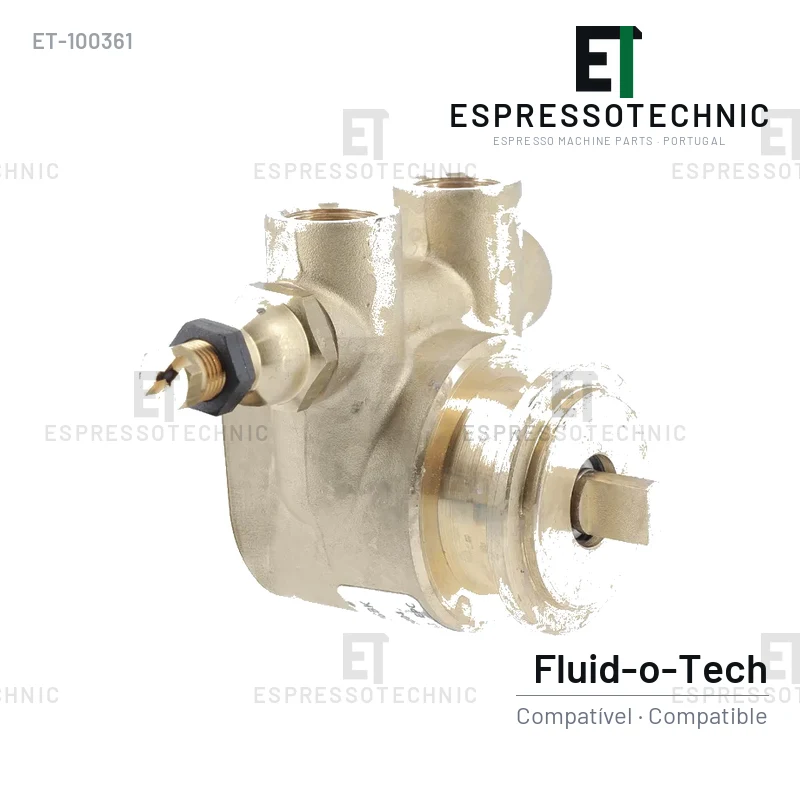
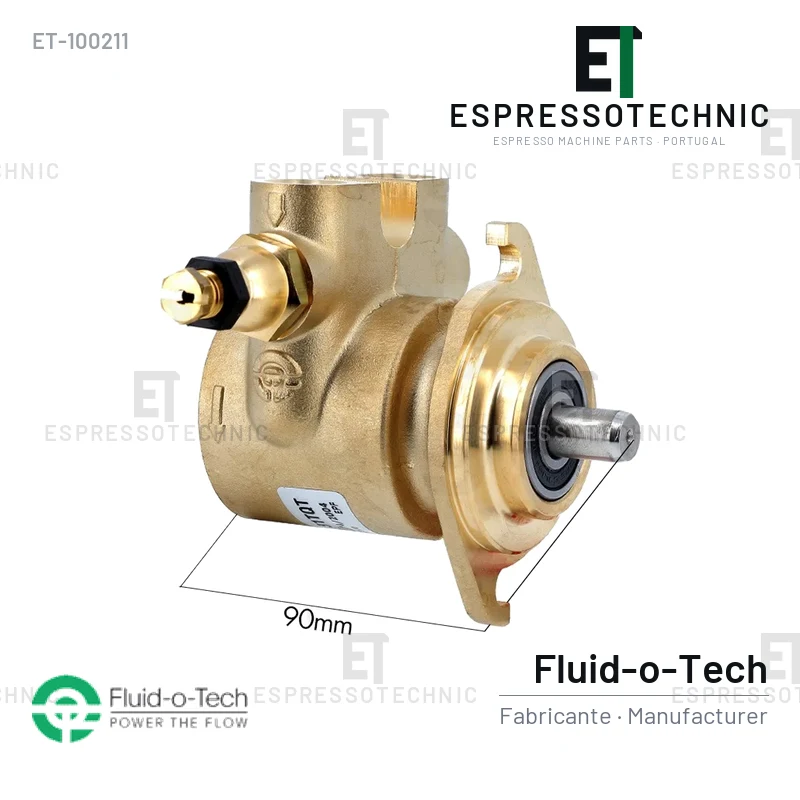
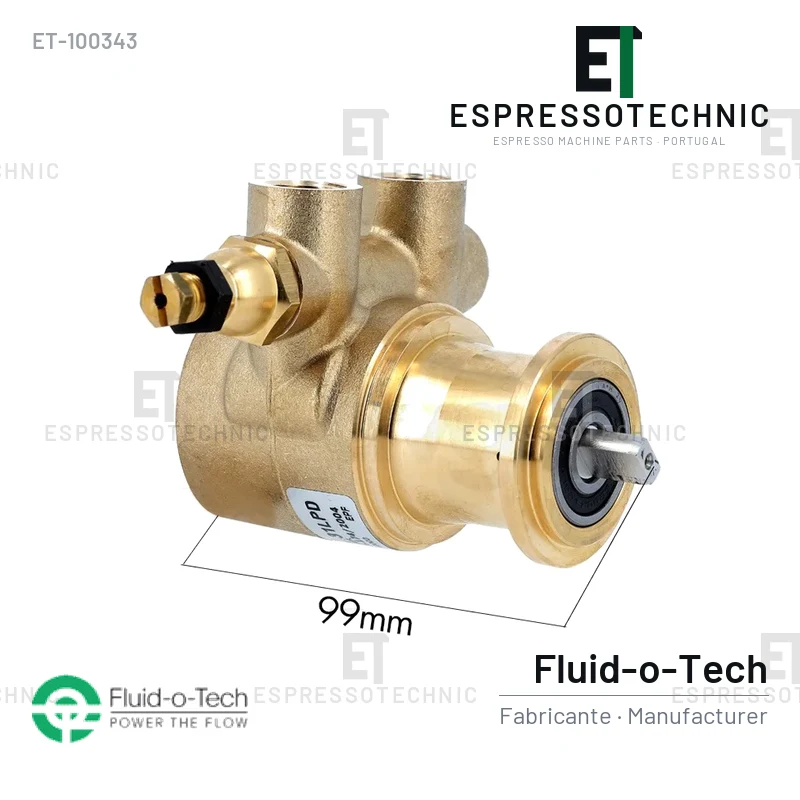
Look for the motor. A metal pump head with two 3/8″ threaded ports, fixed to the end of an electric motor, is a rotary pump; it may sit inside the machine or outside it, under the counter. A small body with a coil, two electrical terminals and a hose inlet is a vibratory pump.
As a rule, plumbed-in professional machines use a rotary pump and compact tank-fed machines use a vibratory pump. Note the label data (maker, model, flow rate or power) before asking for a part.
What are the symptoms of a failing pump?
The most common signs are pressure that does not reach the set value or that fluctuates, a new noise, a water leak and a motor that does not turn. On a rotary pump, each symptom has a likely cause:
- Low or unstable pressure during extraction: worn graphite parts, a dirty or worn by-pass, or too little water at the inlet.
- Noise: a dirty filter or an insufficient water supply causes cavitation, which is audible and speeds up internal wear.
- Leak from the drain holes: a persistent leak points to the mechanical seal, which wears quickly when the pump runs dry.
- Motor stalled or thermal protection tripping: the pump may be blocked, for instance by a foreign object, in which case machine manuals call for it to be replaced.
On a vibratory pump, the usual signs are loss of pressure and of flow; first rule out a lack of water or air at the inlet and an expansion valve that opens too early.
What should be checked before replacing the pump?
First confirm that the problem is not upstream or downstream of the pump: a new pump will not cure a poor water supply.
- Water at the inlet: tap open, hose not kinked and mains pressure within the range in the manual: 2 to 6 bar on the La Marzocco Linea Classic; 1 to 5 bar on Astoria and Wega machines, with a pressure reducer above that.
- Pump filter: manuals list a blocked inlet filter as a cause of missing water; clean it or replace it.
- Pressure gauge: a faulty gauge gives wrong readings even when the pump is healthy.
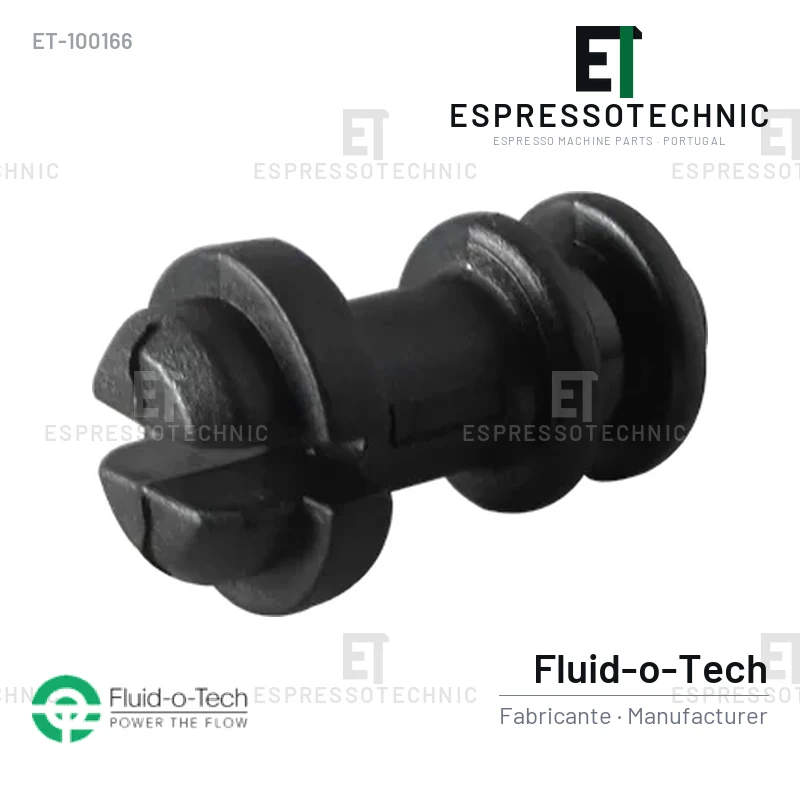
- By-pass: if the pressure does not respond to the adjusting screw, the by-pass may be dirty or worn; on some pumps the by-pass piston is available as a separate part.
Pumps and by-pass pistons are listed under Valves & Pumps; pump filters under Baskets & Shower Screens.
How do I choose and fit the replacement pump?
Choose a pump of the same type, with the same nominal flow, the same mounting and the same connections as the one fitted. Pumps from one series can look identical from outside and have different flow rates, and the manufacturer warns that a different capacity may damage the system, the motor and the pump itself.
- Nominal flow in l/h, read from the label.
- Mounting to the motor: clamp ring or bolted flange.
- Connections: 3/8″ GAS or NPT, which are not interchangeable.
- By-pass and material: with or without a built-in valve; body in brass, low-lead brass or stainless steel.
- Vibratory pump: voltage, frequency, power and type of connections.
When fitting, leave the protective caps on the ports until the fittings go in, check that the shaft turns freely once the pump is coupled to the motor, fit an upstream filter that keeps out particles larger than 10 µm (Fluid-o-Tech states that larger ones quickly wear the graphite) and make sure there is water at the inlet before start-up. The pressure then has to be set again. Fittings are listed under Tubing & Fittings.
FAQ
- Can I swap a vibratory pump for a rotary one?
- Not as a direct swap. A rotary pump needs a motor, space, different plumbing and a different way of setting the pressure: that is a conversion, not a replacement. For a repair, fit a pump of the same type.
- Can a rotary pump run dry?
- No. Although it is self-priming, dry running causes overheating and fast wear of the mechanical seal and internal parts, according to the Fluid-o-Tech instructions.
- Is it normal for a new rotary pump to drip?
- A few drops from the drain holes during the first hours of operation are considered normal by the manufacturer. If the leak continues after that, the pump should be checked.
Related part families
Prices and availability on request. We reply in English or Portuguese.